 training calendar


One of the richest and most interesting elements of Emotional Intelligence is also one of the behaviors our world is most in need of these days. Reality Testing is the ability or tendency to stop-action at any given moment—and to zero-in on the specific facts of that moment. What was it—literally—that you just said? What was the experience that you and I just had in common? Reality Testing then has me compare these facts and realities to my feelings. Are my feelings and emotions justified given the facts and realities on the ground? And when my feelings are not aligned with or in proportion to the facts, Reality Testing has me question my narrative, to actually change my mind—and by changing my mind, I can actually change my feelings.
Low engagement with Reality Testing results in emotional reasoning. Emotional Reasoning is my using my emotional state to justify my narrative. I don’t trust you, so you must be untrustworthy. I feel outraged, so you must have done something outrageous. I am afraid, so you must be scary. A lack of Reality Testing can lead to overly positive narratives also, which can be just as disruptive—I like and care about you, so your actions are above reproach. Reality Testing counters Emotional Reasoning. Facts and reality lead me to question—and even change my narrative.
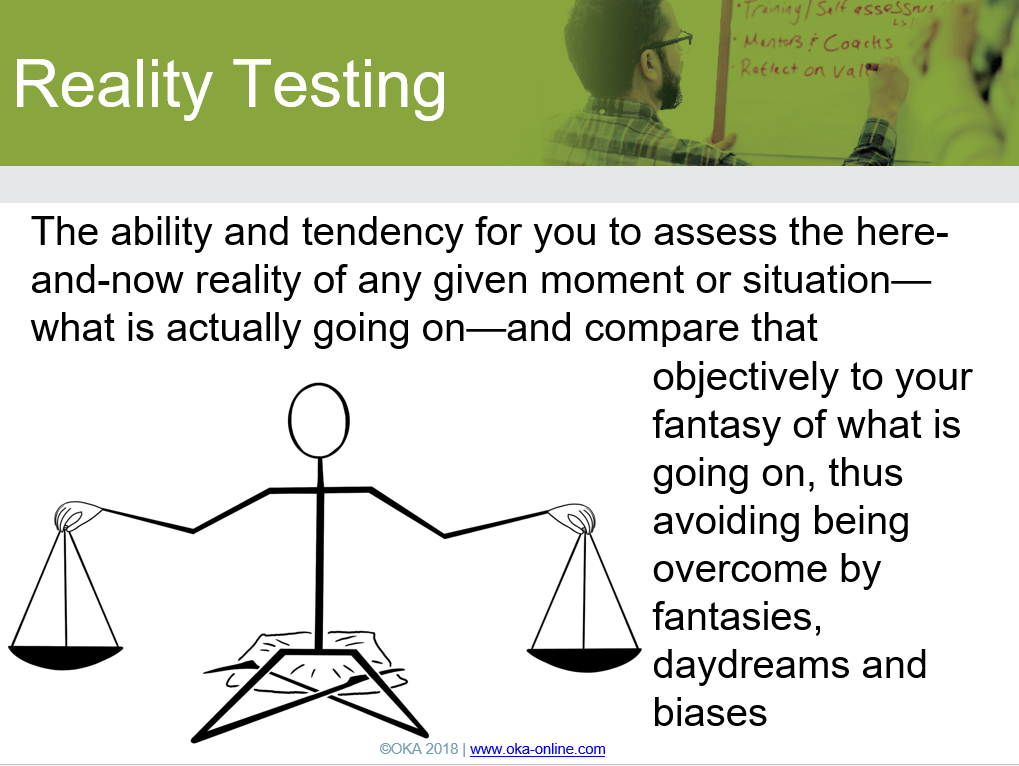
Here’s an example of low Reality Testing. Let’s say you and I are partnering on a project, and I am to take our work output for our colleague, Susan, to review. I come back from that review meeting saying, “Oh my God. That meeting was a disaster—it was a nightmare. Susan hated it! She went rage-mode and yelled at me. It was awful.” But if you could actually view the video of that meeting, you may see that Susan said, “Oh, this report is not what I needed. I thought we were clear about what I wanted to see. I need you do this report again.” Now that is a disappointing meeting—it is not what I wanted to have happen, but was that a nightmare? A disaster? Susan may not have even raised her voice. But here is the important detail—I feel yelled at. I feel yelled at, and to tell you the “truth” of my feeling I have to tell you the story of Susan’s over the top reaction. My feeling is “true,” so my narrative must support that. When fact get in the way of this feeling, these facts must be ignored or changed. This is an example of emotional reasoning. Reality Testing works in direct opposition to emotional reasoning.
One of the “tells” of low Reality Testing is drama.

If you are working on strengthening Reality Testing—your own or someone else’s— here are a few ideas—some actions you can take or encourage to activate this behavior and to create muscle memory in Reality Testing.
• Focus on your language and word choice—taking care to select words and descriptors that accurately reflect your ideas, feelings and observations, without exaggerating, overstating, or being overly dramatic.
• The next conversation or group meeting you find yourself in, pause to consider the specific statements, exchanges, or events—the literal happenings—and consider the emotion that would most logically result from these specifics. Commit to take these thoughtful pauses at least three times throughout the meeting, task or conversation.
• Verify your perceptions. Ask at least two other people to describe an event that you all shared or experienced together, noting the details common to all accounts.
This is brilliant, and so needed by some of my public speaking clients. Do you have any tips for dealing with a client who has low engagement with both reality testing and self-awareness? (And do those two things often go together?)
Hey Jezra,
Actually, working on any of the elements within the EQ-i often results in the increase of many others. For instance, boosting Reality Testing would naturally have a positive impact on Emotional Self-Awareness, Empathy, Self-Actualization, Self-Regard and Optimism. Interesting–there are four elements (of the EQ-i’s 15) whose role is purely data gathering. They serve to collect and inject new data into our lives. Emotional Self-Awareness, Empathy, Reality Testing, and Flexibility–these are the four data-gathering elements, and because of their data-gathering link, they all are a bit connected to each other.
I use the MBTI and do the same type of questioning/analysis and it serves the purpose just fine. In fact, the MBTI can be used for team development, leadership development, and executive coaching.